You can go touring without having trained at all. Just make sure it is flat enough and not too far in between hotels. For the Alps or any other serious mountains, you need to be in good shape. I’m not the right person to give you training advice, but spinning classes twice a week in a gym over the winter months, and 50 km or so each weekend during spring should get you prepared for a summer trip.
If you plan to fly to your biking destination, book a place in advance for your bike when you buy your ticket, or they might not have a cargo place for it. It often costs about €60 or so one way to bring a bike on board.
Is your passport still valid 6 months after you enter the country of your destination? Take copies of all important pages of your passport and give them to a relative or friend. Having some kind of access to these photos might speed things up if your passport is lost and you need to get a new one at your embassy.
Do you need visas? For more adventurous trips, especially in central Asia or Africa, this can be a major hassle. Start this process early. There are some companies that can do this for you, but they’re pricey.
Check your insurance, does it cover you touring on bike, and for all the days of the trip?
Cash is king, so get some of that local variant for coffee and food during the day. Use credit cards mainly for hotels and bigger purchases. And if you travel alone, bring two different credit cards, preferably Visa and MasterCard, linked to two different bank accounts. Store them in different places, in case one is stolen or lost. Also tuck away $100 or so somewhere separate, in case all your other cash/cards are stolen or lost. You can thank me later! Also warn your bank and credit card company in advance that there’s going to be charges made in new countries. Otherwise your cards just might be blocked from suspicious activity.
Also prepare your smartphone before you go. Move all current photos off your phone to your computer and proper backup. Download songs on Spotify and offline maps of where you’ll be biking, and cities you’ll visit. This way you can still listen to music during your trip and put your phone in flight mode while biking and still see exactly where you are and where to go. Plus you don’t have to rely on potentially very expensive mobile data roaming charges. On many trips I have been fine accessing the net only while on WiFi. It works quite well, since pretty much all restaurants, hotels, cafes and even gas stations have free WiFi these days.
You need to make sure you can fit everything into your bags before you go. Bring out everything for the trip, stuff it into your bags, and take a day trip. Does it wobble? Is it uncomfortable?
Also test all your clothes on. Too tight? Has happened to me. Pick something else.
Same thing with bike repair stuff. Does the pump really work? Are batteries OK in the tail light? Can you wrest off the tire with the tools you have? Better check this at home!
It is a good idea to leave your bike for service before you go. Adjust all gears and brake wires, replace worn brake pads. Make a mark on the saddle post so that you can quickly raise it back to the correct height if you unpack it after a flight.
Finally, do some service on your own body. Cut your hair and nails short just before you leave, so you don’t have to worry about it for a while. Men also need to decide if they should maintain a decent shave or go caveman style. Unfortunately, new beards are itchy, so caveman style is better prepared in advance, before the trip.
What if you lose your smartphone?
It is a nightmare to buy a new one and bring everything up again from scratch. I suggest talking to your local phone company at home about getting a spare SIM card for such occasions. If your smartphone is lost, you call your phone company at home and say “I’ve lost my phone, bought a new one (or brought along a spare from home), and have a replacement SIM card with this number: ABC123… Please make the switch on your side”. If they don’t like it for security reasons (someone might hack your account using the same method) then ask them in advance what procedure they suggest instead. In Sweden you can get a special security code from your phone company for exactly these circumstances. Of course, that spare SIM-card should be stored separately from other important cards, money and documents, in case you end up being robbed. Also, get security backup codes of your main Google or iPhone account. Give them to a close friend or relative you can call in case you need these codes. This whole issue is a major pain, I have been through this twice, and don’t want to do it ever again.
Bags for packing a bike for flying
If you fly with your bike, then it will be exposed to the airport crunch (called the “Arlanda Crunch” in Stockholm), where bikes are crushed and dented and damaged by careless airport personnel or the conveyor belts and machinery moving luggage around. To prevent this, there are two options:
You can either put your bike in a dedicated bike box. They come in two types. Hard cases like a suitcase, or a cloth bag with some padding. The problem with both is that if you fly to A, bike to B and then fly home from B, how do you transport the dedicated bike box from A to B? For me this is a major drawback. I want to be free to go where the wind takes me. Worrying about an external bulky bag is very low on my priority list.
The other option is to put your bike in a cardboard box. Bike shops are often happy to give them away for free, since their disposal is a pain in the neck for them. A cardboard box is sturdy enough to protect your bike from airport damage. When you arrive at your destination you just unpack your bike and dispose of the cardboard box in a responsible way. When you’re ready to fly home, you get a new cardboard box, which can be a somewhat time consuming and stressful task. It once took me most of a day in Milano, and the result was a monstrosity.
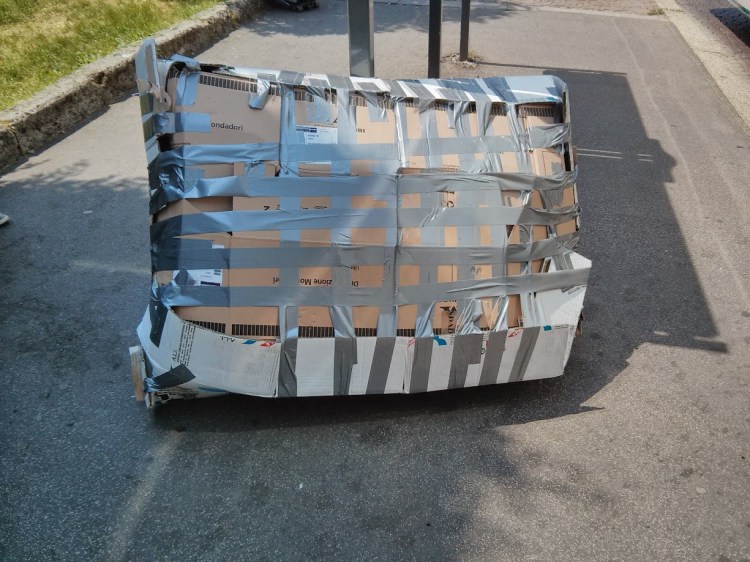
When you wrap up your bike in a cardboard box, use a lot of sturdy gaffa tape. Lots and lots of it. I think you can buy it all over the world.
A plastic bag might seem like an alternative for your bike when flying, except it might be harder to find a new one in B before you fly home. A plastic bag also doesn’t protect your bike when handled at the airport. I haven’t tried this, and don’t think I will either. It really sucks to arrive at your destination and find out your bike has been damaged.
If you fly home from the same place as you arrive, then a dedicated hard shell bike box is a better choice. But then you need to leave it at a hotel while you’re out biking. Shouldn’t be a problem, really, just be aware that you need to solve this problem.
Bags for packing a bike for train or bus
Since I quit flying in 2017 I have transported my bike mostly on trains about a dozen times throughout Europe. For several years this worked somewhat well with a €20 large plastic fiber bag I found in a store in Almería in Spain.
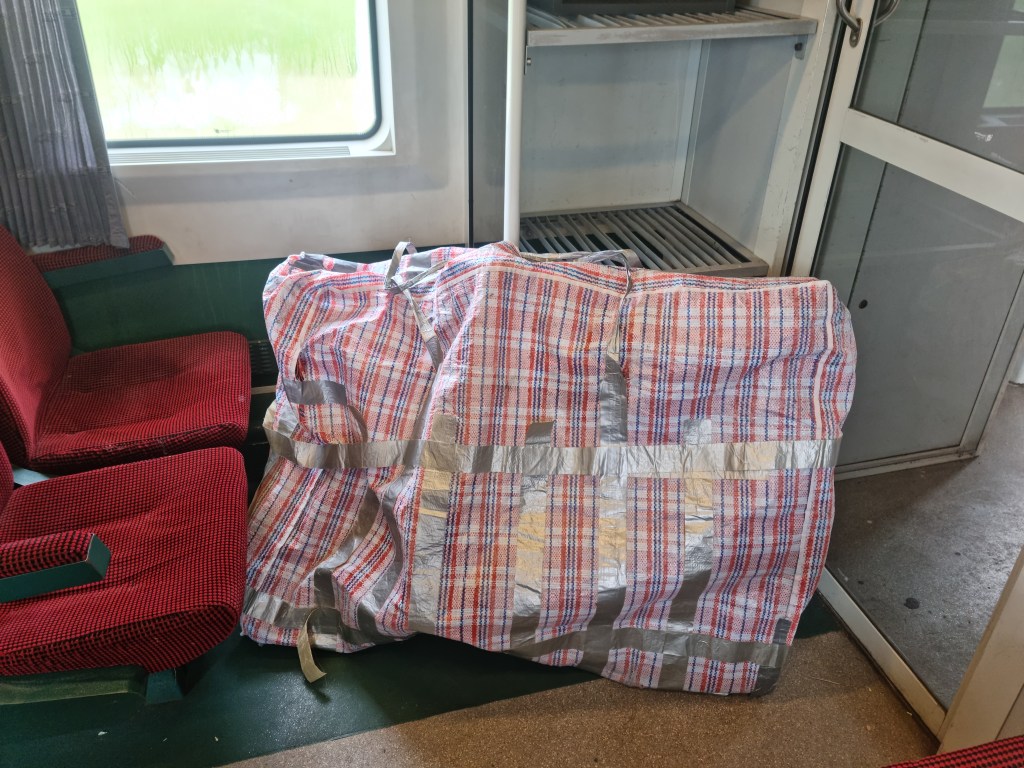
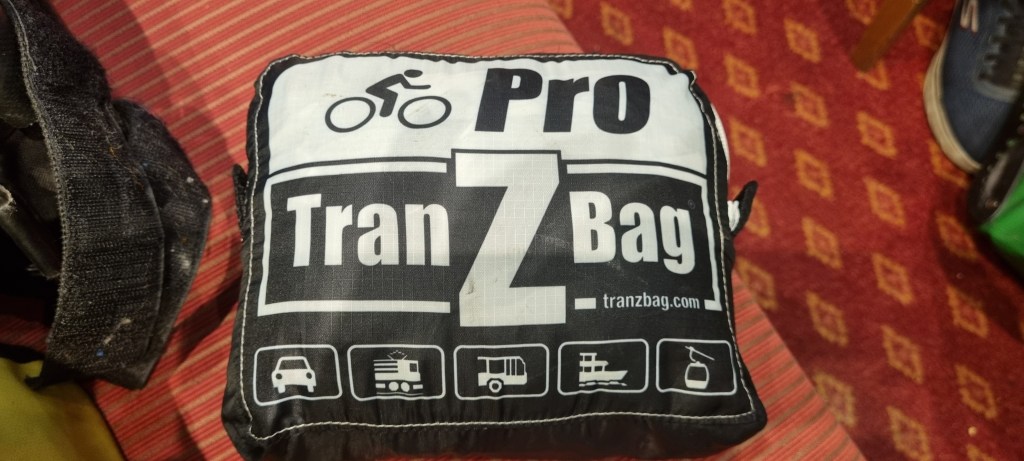
It was compact enough to be wrapped into my bags and brought with me when biking from A to B. However, it was slowly disintegration despite perhaps 10 meters of applied gaffa tape, and I think that size of bag has stopped being produced. I desperately searched for it on Chinese shopping sites with no success. Then, on a recent trip to the Balkans I bumped into an experienced long distance bike who introduced me to the dedicated TranzBag. It is somewhat pricey (my Pro version is €180) but I have now used it twice without it breaking. And it packs really small, around a liter size.
Packing a bike for transport is simple in theory, just remove the wheels and stuff it all in. In reality, you might also have to twist the handle bars 90° to fit into the bag (and possibly also to save your bike from the crunch). You may also need to lower the saddle to make the bundle less bulky. And twist off the pedals. And release all air from the tubes. This is quite simple at home, but re-assembling it all at the destination requires tools and skills. You don’t want to bring along heavy wrenches or other tools, unless you can leave them behind in the bag while you are biking, so doing this with tiny wimpy tools might be your only choice. Test this at home before you go, and don’t do a sloppy job when it comes to securing your handlebars back from the 90° twist! You don’t want to see it getting loose in a sharp turn down some crazy alpine switchbacks! And don’t do a sloppy job with twisting back on the pedals either. I did so in Morocco and it ended with one pedal falling off while I was going down a hill!
Here are more tips about packing bikes for air travel, by an expert.
Another thing you might experience is that the rear derailleur won’t be as finely adjusted after you’ve re-assembled the bike at your destination. You’ll either need to know how to fix this yourself, or roll into a bike shop and ask for help. Do this as soon as possible, as bike shops might be far in between.
 Credit Card Bike Touring